What to Include on an Invoice: The Complete Checklist
What to put on an invoice: a copy-paste checklist of every field a professional invoice needs — EU-specific extras and the optional bits that quietly accelerate payment.
There's no single, universal “invoice format,” so “what do I put on an invoice?” has no one-line answer. Different countries require different fields, different industries have different conventions, and every accounts payable team has its own quirks. But if you cover the items in this checklist, your invoice will satisfy 99% of clients in 99% of jurisdictions — and the remaining edge cases are usually one extra line away.
Here's what that looks like in practice. Every numbered field below is one line on the checklist that follows:
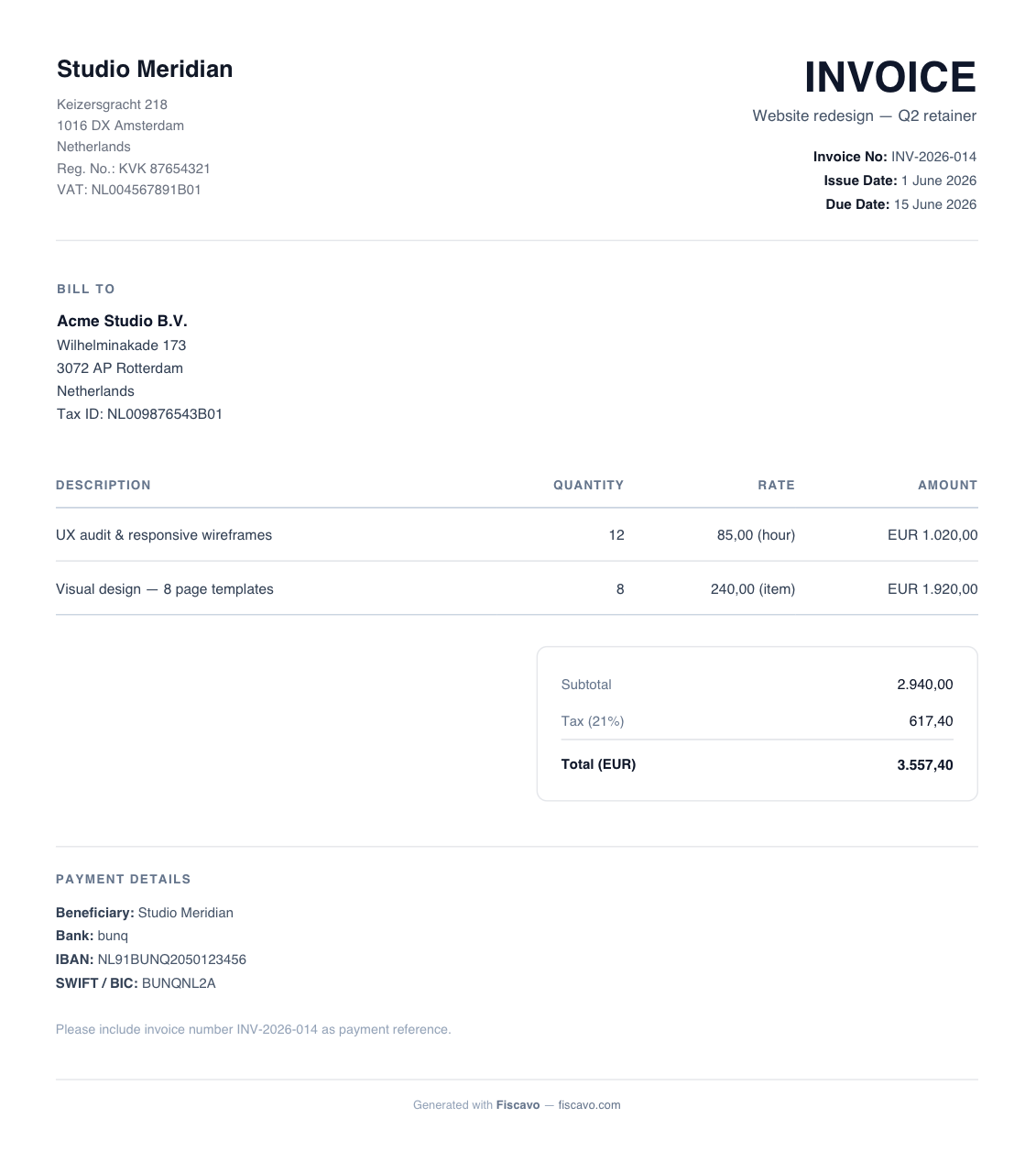
The universal essentials
These appear on every legitimate invoice, regardless of country or industry:
- The word “Invoice” — explicitly. Not “Statement” or “Bill.”
- A unique invoice number — sequential or coded, but never reused.
- Issue date — when you issued the invoice.
- Due date — an explicit calendar date, not just “Net 30.”
- Your business name and address — the legal name that matches your bank account and contract.
- Your tax/VAT number if you have one.
- Client's legal name and billing address — not the trading name, the legal name on the contract.
- Itemized line items with description, quantity, unit, and rate per line.
- Subtotal, tax, total — broken out, in that order.
- Currency — explicit (EUR, USD, GBP). Don't rely on the symbol alone.
- Payment instructions — bank account details (IBAN + SWIFT for international), or a payment link.
EU-specific extras
If you're VAT-registered and trading within the EU, add these:
- Your VAT number with country prefix — e.g.
LV40003123456, not just40003123456. - Client's VAT number if they're VAT-registered. For cross-border B2B, this is mandatory.
- A reverse-charge note when you're not charging VAT on a cross-border B2B sale: “Reverse charge — Article 196 of Directive 2006/112/EC.”
- Place of supply for digital services to non-business customers in another EU country (OSS scheme applies).
- Business registration number in some countries (e.g. Handelsregister in Germany, SIRET in France).
Optional, but quietly accelerates payment
None of these are required. All of them shave days off your average days-to-paid:
- Purchase order (PO) number. If the client gave you one, quote it. AP teams use the PO as the matching key — without it your invoice sits in an exception queue.
- Project or contract reference. “Project: Acme Q1 onboarding.” Helps the recipient route the invoice internally.
- Payment terms in plain English. “Payment due 14 days from invoice date. Late payments accrue interest at 8% above ECB base rate per Late Payment Directive 2011/7/EU.” The legal citation isn't threatening — it's informative, and it gives you a clean basis to chase late-payment interest if it comes to that.
- Accepted payment methods. “Bank transfer (preferred), Wise, or Stripe.”
- Contact for invoice queries. An email and phone number for accounting questions. A separate “billing@” address works well.
- A thank-you line. One sentence at the bottom: “Thanks for the work — let's do more in Q2.” Costs nothing, keeps relationships warm.
Bank details: how much to include
For EU-to-EU payments, IBAN alone is usually enough — SEPA handles the routing. For everything else, include:
- Account holder name (must match your business legal name)
- IBAN
- SWIFT/BIC (required for non-EU transfers)
- Bank name and address (some receiving banks require this)
- Reference field hint: “Please include invoice number INV-2026-014 as the payment reference.”
If you accept multiple currencies, list the relevant account first. Don't bury the EUR IBAN under a USD account if the invoice is in euros.
The printable checklist
Invoice header: word “Invoice”, unique number, issue date, due date. From: legal name, address, VAT number. To: client legal name, address, VAT number, PO number if any. Line items: description, quantity × rate per line. Totals: subtotal, tax (rate + amount), total — in the agreed currency. Tax notes: reverse-charge citation if applicable. Payment: account holder name, IBAN, SWIFT/BIC, reference hint. Terms: explicit days, late-payment clause. Footer: contact for invoice queries.
FAQ
What do you put on an invoice?
Every invoice needs the word “Invoice”, a unique invoice number, the issue and due dates, your business name, address and VAT number, the client’s legal name and address, itemised line items with quantity and rate, a subtotal, tax and total in an explicit currency, and clear payment instructions. Inside the EU, add both parties’ VAT numbers and a reverse-charge note on cross-border B2B sales.
Do I need to include my bank details on every invoice?
Yes — or a payment link that resolves to bank details. Don’t make the client dig through old emails for your IBAN. The few seconds it saves them is the difference between “pay now” and “pay later.”
What if my client and I are both VAT-registered in the same country?
Charge VAT at the standard local rate. Reverse charge only applies to cross-border B2B transactions within the EU (and a few specific domestic scenarios like construction services in some jurisdictions).
Should I include payment terms even if we agreed verbally?
Always. If terms aren’t on the invoice, the client’s default policy applies — and corporate defaults can be 60 or 90 days. Write the terms on every invoice, even with long-term clients.
What to read next
- How to Write a Freelance Invoice (With Examples)
A practical, jargon-free guide to writing a freelance invoice that gets paid on time. Includes the eight essentials, a worked example, and EU-specific notes on VAT and reverse charge.
- How to Chase Unpaid Invoices Politely: Templates + Late-Payment Interest
Chase unpaid invoices and get paid — a calm five-step sequence with copy-paste reminder email templates, when to send each one, and the late-payment interest you're owed.