How to Invoice as a Freelance Software Developer (EU Guide)
A practical invoicing guide for freelance and contract software developers in the EU — day vs hourly rates, what to put on the invoice, and the cross-border VAT reverse-charge rules that trip up most B2B devs.
Freelance software developers invoice differently from most freelancers. The work is almost always B2B, the amounts are large, the engagements run for months, and — because good developers work remotely — the client is frequently in another country. That last point is where invoices go wrong: a backend contractor in Lisbon billing a startup in Berlin is a cross-border B2B transaction, and the VAT treatment is not the same as a local invoice.
This guide covers what belongs on a developer’s invoice, how to bill day rates and retainers cleanly, and the reverse-charge rules that decide whether you add VAT or not.
What goes on a developer’s invoice
The legal essentials are the same as any B2B invoice, but a few fields matter more for contract dev work:
- Your details and VAT ID — name/company, address, and your VAT identification number. For cross-border EU work the VAT ID is non-negotiable.
- The client’s details and VAT ID — including their VAT number, which you’ll need for the reverse charge.
- A unique invoice number and the issue + supply dates.
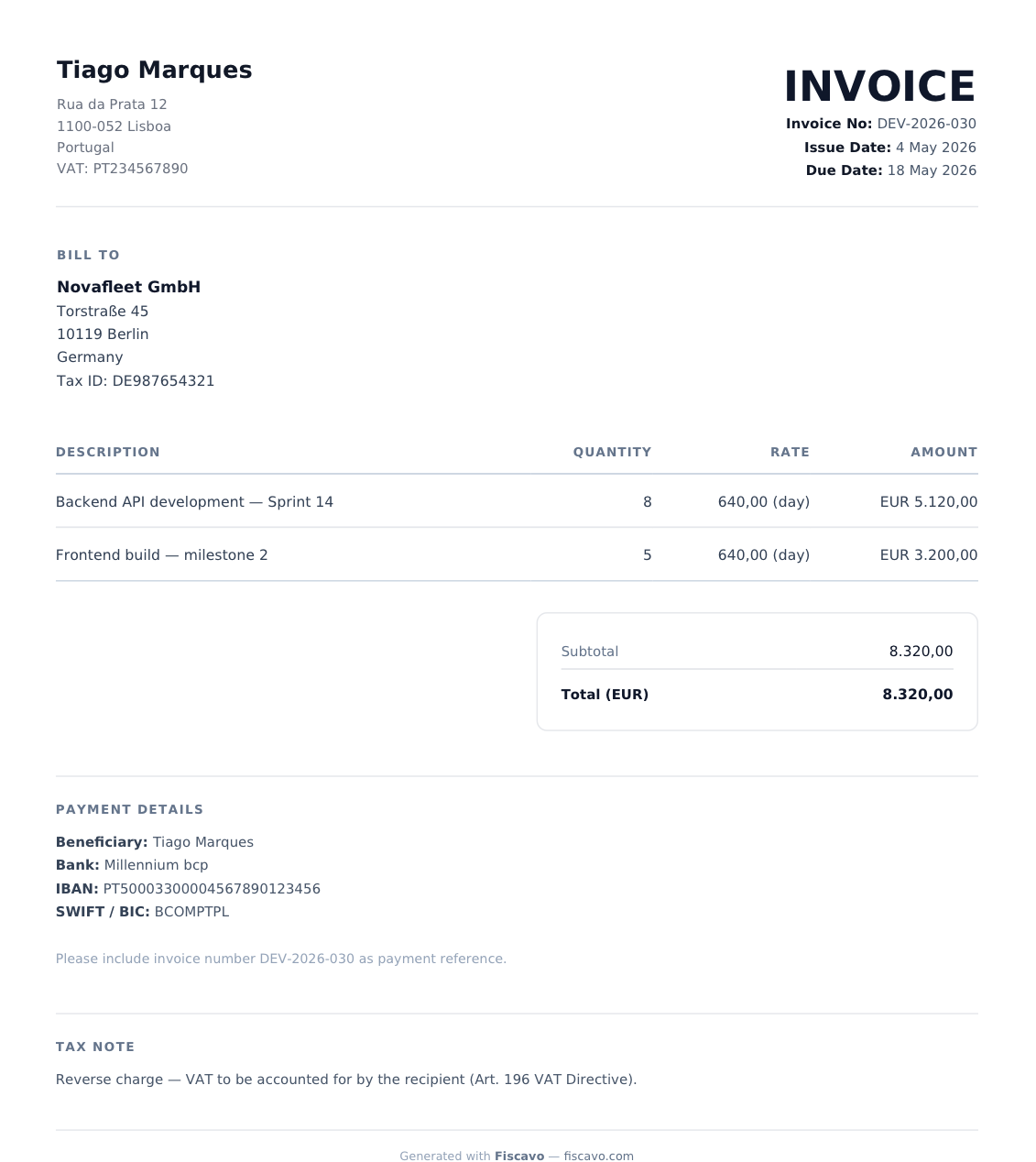
- A specific description — not “consulting.” Write “Backend API development — Sprint 14” or “Frontend build, milestone 2.” Vague descriptions are the number-one reason an accounts-payable team parks your invoice.
- Rate, quantity and unit — e.g. 8 days × €640/day. Show the unit (hour / day / month) explicitly.
- Subtotal, VAT (or the reverse-charge note), and total.
- Payment terms and how to pay — due date, IBAN/bank details, and any PO or reference the client asked for.
Rate models: hourly, daily, milestone, retainer
Most dev contracts use one of four shapes, and each maps to a clean line item:
- Hourly — best for ad-hoc work and small fixes. List hours × rate.
- Daily — the default for sprint-based contract work. List days × day rate.
- Milestone / fixed-price — invoice on delivery of each milestone, ideally with a deposit up front.
- Monthly retainer — a fixed monthly amount for ongoing availability; one recurring line item per month.
The part that trips developers up: cross-border VAT
Whether you put VAT on the invoice depends entirely on where your client is and whether they’re a business:
- Client in your own country — charge your local VAT rate as normal.
- Business client in another EU country — this is the common case for remote devs. You apply the reverse charge: you invoice with no VAT, and your client accounts for it in their country. The invoice must carry both VAT IDs and a note such as “Reverse charge — VAT to be accounted for by the recipient (Art. 196 VAT Directive).”
- Client outside the EU (US, UK, etc.) — the service is generally outside the scope of EU VAT, so no VAT is charged.
Two things make the reverse charge valid: a real, verifiable client VAT number, and reporting the sale. Always check the client’s VAT ID against VIES (the EU’s validation system) before you invoice — if it’s invalid, the reverse charge doesn’t apply and you may owe the VAT yourself. These sales also go on your recapitulative statement (the EC Sales List equivalent in your country).
E-invoicing is coming to B2B
Several EU countries are making structured e-invoicing mandatory for B2B over the next couple of years (Germany, France, Poland, Spain and others on staggered timelines). A PDF won’t be enough — invoices will need a structured format like Peppol BIS, XRechnung, Factur-X or FatturaPA, all built on the EN 16931 standard. If you contract across borders, pick a tool that already outputs these so you’re not re-tooling later.
Payment terms that get developers paid
Net 14 or net 30 is standard for dev contracts. For fixed-price projects, take a deposit (commonly 30–50%) before starting and invoice the rest on milestones — it protects your cash flow and filters out clients who were never going to pay. State late-payment terms explicitly; in the EU you’re entitled to statutory interest and a recovery fee on overdue B2B invoices.
Common mistakes
- Vague line descriptions that invite questions and delay.
- Forgetting the reverse-charge note (or charging VAT when you shouldn’t).
- Not validating the client’s VAT ID on VIES.
- Missing the PO number or reference the client’s finance team requires.
- Invoicing in the wrong currency, or not stating which currency the total is in.
In short
A developer’s invoice is a normal B2B invoice with two things done carefully: a precise description of the work, and the right VAT treatment for where your client sits. Get the reverse charge right and your cross-border invoices sail through. Create your first developer invoice here — the VAT logic is built in.
- What to Include on an Invoice: The Complete Checklist
What to put on an invoice: a copy-paste checklist of every field a professional invoice needs — EU-specific extras and the optional bits that quietly accelerate payment.
- How to Chase Unpaid Invoices Politely: Templates + Late-Payment Interest
Chase unpaid invoices and get paid — a calm five-step sequence with copy-paste reminder email templates, when to send each one, and the late-payment interest you're owed.